Articles
Mushrooms, the MIND Diet and Brain Health
When you think of mushrooms, what comes to mind? A favorite pizza topping? The secret to a rich, umami-packed sauce? The best part of a green bean casserole? Mushrooms are so much more! In fact, they are nutrient-packed foods that bring bold flavor to the table with ease. Mushrooms provide nutrients and bioactive compounds that support overall wellness, including ergothioneine, or ERGO, an amino acid that is being examined for its role in brain health (read more). And mushrooms are one of the top food sources of ERGO.
It makes sense then that mushrooms are included in the MIND diet, a plant-forward eating pattern that specifically focuses on supporting cognitive health. Read on for more about how mushrooms may play a role in fueling your brain, and the most delicious and easiest ways to enjoy them throughout your day. Because when something tastes this good and fits into a brain-healthy eating pattern, it’s not magic – it’s mushrooms.
What is the MIND Diet?
The MIND diet, short for the Mediterranean-DASH Diet Intervention for Neurodegenerative Delay, is a hybrid of the Mediterranean and DASH (Dietary Approaches to Stop Hypertension) diets. It was developed specifically to support brain health and reduce the risk of cognitive decline.
This eating pattern emphasizes plant-forward foods, especially non-starchy vegetables (like mushrooms) and leafy greens, along with berries, nuts, beans, whole grains, olive oil, fish and poultry. Studies suggest adherence to the MIND diet is linked to lower cognitive impairment and slower rates of cognitive decline1 (read more).
ERGO Explained
Ergothioneine, also known as ERGO, is an amino acid that’s being explored for its role in brain health. Lower blood levels of ERGO may be associated with the severity of cognitive disease.2
An analysis of U.S. adults aged 60 and older using NHANES data found that participants who reported eating more mushrooms performed better on several cognitive tests, including measures of memory and processing speed. These encouraging results suggest mushrooms could play a role in supporting normal cognitive function in aging. Because the study was cross-sectional and relied on self-reported diet, the findings show associations rather than cause and effect. Still, this nationally representative study highlights a promising link that warrants further prospective and clinical research to better understand the potential role of mushrooms in maintaining brain health.1
Unlike many nutrients, the body can’t produce ERGO on its own, meaning it has to come from food.
That’s where mushrooms shine. As one of the top food sources of ERGO, it may be surprising that something so delicious contains such a unique nutrient being studied for its role in brain health – but it’s not magic. It’s mushrooms.
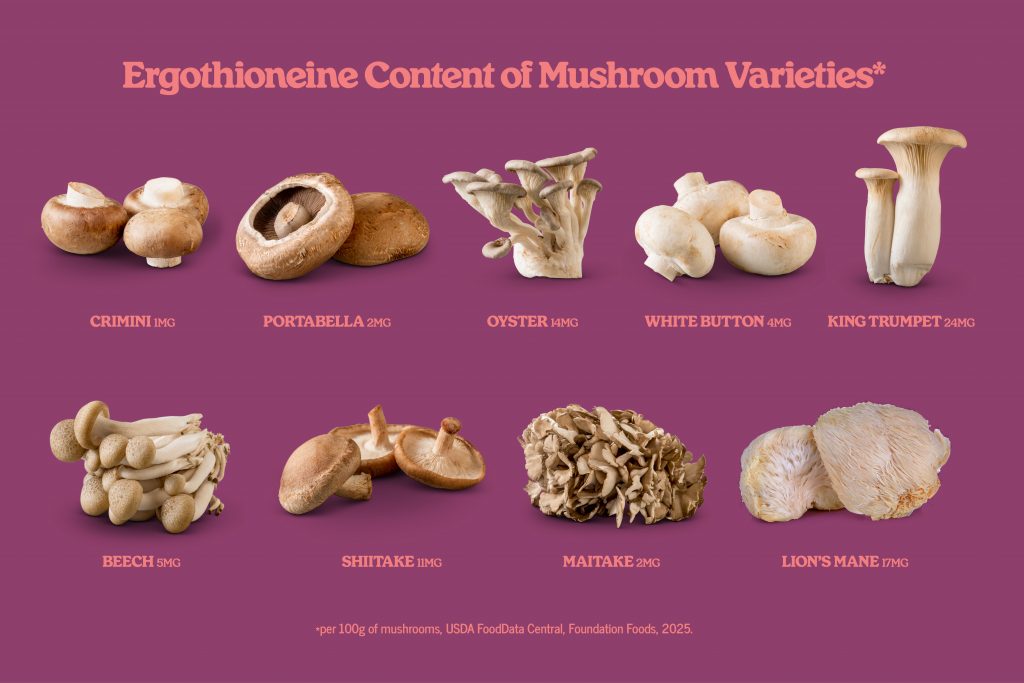
Certain varieties like king trumpet, oyster and lion’s mane have some of the highest levels, while common varieties like white button and crimini contain more ERGO than most other foods. Smaller amounts of ERGO also are found in some fermented foods and in plant foods grown in soil shared with fungi.
Easy Ways to Eat More Mushrooms — From Breakfast to Dinner
Adding mushrooms to meals is simple, and their versatility makes them easy to enjoy any time of day. Finely chopped mushrooms blend easily into burgers, meatballs or taco fillings, while roasting them brings out rich umami flavor for bowls and salads. They’re also great sautéed in eggs, added to pizza or mixed into soups and sauces.
From breakfast to dinner, mushrooms take the lead in these three recipes packed with MIND diet-friendly ingredients.
Breakfast: Mushroom, Sweet Potato and Kale Breakfast Skillet
This hearty skillet combines mushrooms with kale, sweet potatoes and olive oil — key components of the MIND diet.
Lunch: Pressure-Cooker Blended White Bean Chili
A comforting option featuring mushrooms, beans, onions and olive oil for a satisfying meal. 
Dinner: Grilled Cajun-Style Mushroom Kebabs
Pair mushrooms with bell peppers, cherry tomatoes and onions and serve alongside whole grain rice and olive oil for a brain-boosting dinner.

Eating a variety of mushrooms several times a week is a simple, delicious way to get more ERGO in your diet and give your brain something to thank you for later.
1 Ba DM, Gao X, Al-Shaar L, Muscat J, Chinchilli VM, Ssentongo P, Beelman RB, Richie J. Mushroom intake and cognitive performance among US older adults: the National Health and Nutrition Examination Survey, 2011-2014. Br J Nutr. 2022 Dec 14;128(11):2241-2248. doi: 10.1017/S0007114521005195. Epub 2022 Feb 4. PMID: 35115063; PMCID: PMC9661370.
2 Wu LY, Cheah IK, Chong JR, Chai YL, Tan JY, Hilal S, Vrooman H, Chen CP, Halliwell B, Lai MKP. Low plasma ergothioneine levels are associated with neurodegeneration and cerebrovascular disease in dementia. Free Radic Biol Med. 2021 Dec;177:201-211. doi: 10.1016/j.freeradbiomed.2021.10.019. Epub 2021 Oct 19. PMID: 34673145.